

At NSDTA 2026, Lyssn joined workforce development leaders from Iowa and Wyoming for “Doing It Right: Two Jurisdictions’ Journeys to Fidelity Monitoring of Evidence-Based Practices,” a conversation about what it takes to move from training staff in evidence-based practices to supporting those skills in day-to-day work.
The panel brought together Maria Vasquez James, Social Services Policy Analyst with the State of Wyoming Department of Family Services; Ashley Johnson, Director of Learning & Evaluation with the Coalition for Family & Children’s Services; and Michael Tanana, PhD, Chief Technology Officer at Lyssn.
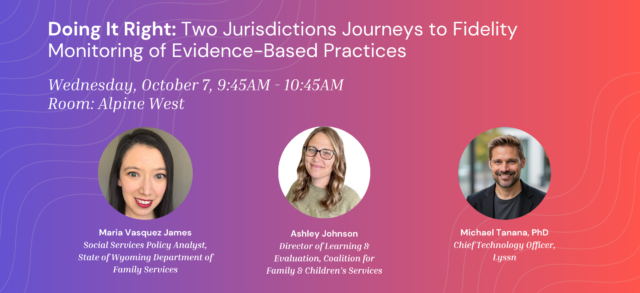
Drawing on real-world implementation experiences across different systems, the group explored how agencies can build fidelity monitoring into a broader approach to workforce development, coaching, and continuous improvement.
Here are a few of the key takeaways from the session.
Training Completion Is Not the Finish Line
Completing training is important, but it doesn’t tell us whether new skills are making their way into practice. As the panel discussed, completion and knowledge measures can show that someone participated in training and understood the material. They don’t necessarily show whether staff are consistently using the intended skills in their work with children and families.
Organizations invest heavily in evidence-based training, but the support that comes after training plays an important role in helping new skills stick.
Connecting Training to Practice
Rather than stopping at training, the panel introduced a fuller implementation cycle that looks like this:
- Train
- Practice
- Observe
- Feedback
- Coach
- Measure
- Adapt
Instead of viewing training as a one-time event, this approach connects learning with opportunities to practice, receive feedback, build skills through coaching, and understand what is happening in real-world interactions.
Fidelity monitoring is one piece of that cycle. Its value comes not from simply measuring performance, but from giving organizations information they can use to strengthen their workforce.
Turning Fidelity Data Into Workforce Development
One of the biggest discussion points was what happens after fidelity data is collected. Rather than treating every score as an individual performance issue, the panel encouraged leaders and supervisors to ask these questions:
- Are there skills that need additional practice or reinforcement?
- Are supervisors equipped to coach staff in those areas?
- Are workflows or implementation conditions making a practice difficult to use?
- Would targeted booster training help address a common challenge?
From there, organizations can respond with focused coaching, learning opportunities, or system changes and continue measuring to understand whether those supports are helping. This creates an ongoing feedback loop between training, practice, data, and workforce development, rather than treating fidelity monitoring as a one-time assessment.

Different Systems, Different Paths
The experiences shared by Iowa and Wyoming also reinforced an important point: there isn’t one universal model for implementing fidelity monitoring. Agency structures, available resources, training systems, supervision models, and implementation priorities all shape what fidelity monitoring looks like in practice. Rather than waiting until every piece of a system is perfectly designed, organizations can begin with a focused use case and build from there.
The panel suggested a practical framework for getting started:
- Choose: Select one important, observable behavior
- Embed: Put practice and feedback into a structure that already exists
- Learn: Collect enough information to identify patterns and barriers
- Respond: Use the information to target coaching, learning, or system changes
Starting small gives organizations an opportunity to learn what works within their own environment before expanding the approach.

Key Takeaways
A few ideas we’re continuing to think about after the conversation:
- Training completion is an implementation milestone, not evidence that a practice is being used consistently
- Fidelity monitoring becomes more valuable when the information is connected back to coaching, learning, and workforce development
- Implementation will look different across jurisdictions and organizational structures
- Agencies don’t need a perfect system to begin, one observable behavior and a meaningful feedback loop can be a practical place to start
Thank you to Maria Vasquez James and Ashley Johnson for sharing their experiences alongside Lyssn’s Michael Tanana, and to the NSDTA community for creating space for conversations about what it really takes to support staff beyond the training room. At Lyssn, we’re working with Health and Human Services organizations to connect training, skill development, feedback, and quality improvement so agencies can better understand how evidence-based practices are showing up in real-world interactions.
Interested in learning more about how Lyssn supports fidelity monitoring and workforce development? Get in touch with our team.