

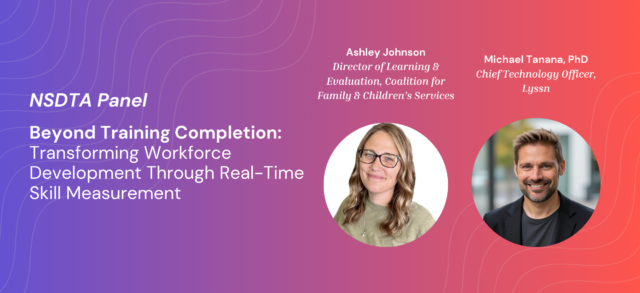
At this year’s National Staff Development and Training Association (NSDTA) conference, Michael Tanana, PhD, Chief Technology Officer at Lyssn joined Ashley Johnson, Director of Learning & Evaluation with the Coalition for Family & Children’s Services of Iowa, for “Beyond Training Completion,” a session focused on what it takes to move from tracking training participation to understanding whether new skills are actually showing up in practice.
The conversation explored how workforce development teams can connect learning, practice, feedback, coaching, and measurement to get a clearer picture of what staff can do — not just what they’ve completed.
The Problem with “97% Completion”
One of the questions at the center of the session was simple: If your dashboard says 97% of staff completed a training, what does that actually tell you about what they can do?
Completion data serves an important purpose, but it only tells part of the story. For years, the traditional training story has followed a familiar arc — staff attend a course or module, the LMS records a completion, and a certificate becomes the primary evidence that learning occurred. Those measures answer an important administrative question, but they don’t necessarily show whether someone can apply the skills in practice.
A New Framework: From Completion to Competence to Continuous Improvement
The panel offered a simple framework for thinking beyond completion:
- Completion — Did they take it?
- Competence — Can they demonstrate it?
- Continuous Improvement — How do we use what we learn to strengthen the workforce?
That shift changes what workforce development teams are looking for. Instead of stopping at participation, organizations can begin looking at whether staff can demonstrate key skills, where additional support may be needed, and how that information can shape future learning and coaching.

The Workforce Development Cycle
The session also introduced a practical workforce development cycle that connects learning with ongoing opportunities to practice, receive feedback, and improve.
- Learn
- Simulate
- Demonstrate
- Feedback
- Coach
- Repeat
- Measure
Technology can help support this cycle by making practice, feedback, and measurement more accessible, but it doesn’t replace the role of supervisors, coaches, and other workforce development leaders. The goal is to give those teams better information and more opportunities to reinforce skills, not to remove the human support that helps learning translate into practice.
Data that Drives Decisions
Another theme of the session was making workforce data useful, not simply visible. A large dashboard may show a lot of information, but the more important question is what an organization does with what it learns.
Attendees were encouraged to think about:
- Skills staff are demonstrating consistently
- Areas where additional practice or coaching may be needed
- Patterns across teams or groups
- Changes that could strengthen future training or implementation
One prompt from the session captured that idea well: “Because we saw ___, we changed or created ___.” That connection between measurement and action is what turns workforce data into a tool for continuous improvement.

The Takeaway
Moving beyond training completion doesn’t mean completion data stops mattering. It means organizations have an opportunity to build on it. When training systems include opportunities to practice skills, demonstrate competence, receive feedback, and use data to guide coaching and future learning, workforce development becomes an ongoing process rather than a one-time event.
Thank you to Ashley Johnson for sharing her workforce development experience alongside the Lyssn team, and to the NSDTA community for continuing the conversation about how training can better support staff in real-world practice. At Lyssn, we’re working with human services organizations to connect learning, practice, feedback, and measurement so workforce development teams can better understand where skills are strong and where additional support may help.
Looking for ways to connect learning, practice, feedback, and measurement across your workforce development efforts? Connect with our team to learn more about how Lyssn can support your organization.